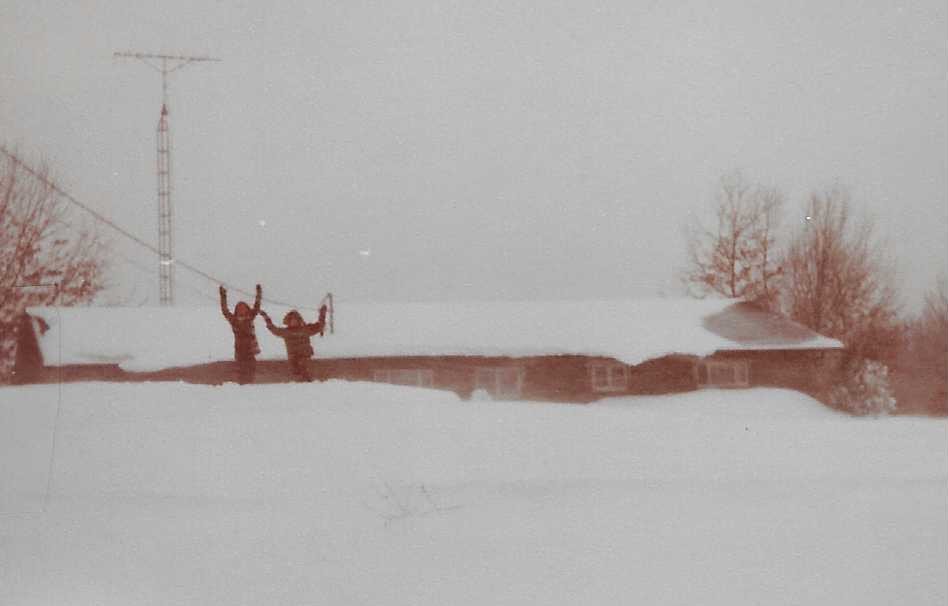
The Storms
THE COUNTY REMEMBERS ONE WINTER … THE RECORD SHOWS TWO.
What the Hillsdale weather station logged during the winters of
1977 and 1978 — and which one actually kept the buses in the garage.
When the Historical Society described the winter worth writing about, it came
out the way these things always come out: a disastrous winter in the late
1970s, a huge amount of snow, rural districts calling many snow days. No
date. A season, not a storm.
That description fits two different winters, back to back, and they were not
the same winter at all. One of them was bitterly cold. The other buried the
county. Memory has spent fifty years folding them into a single bad stretch,
which is exactly what memory is for and exactly what a weather log is not.
So here is the log.
WHERE THESE NUMBERS COME FROM
Hillsdale has kept a weather station since 1891 — station USC00203823,
flagged in NOAA's own station inventory as part of the U.S. Historical
Climatology Network, the tier reserved for stations with long, consistent
records. Someone in this county has been writing down the high, the low, the
precipitation, and the depth of snow on the ground nearly every day for a
hundred and thirty-four years.
Everything below is counted over December 1 through April 30 — the window a
school district actually cares about — except the school-day tables further
down, which run December 1 through March 31 and say so.
Comparisons run against the 115 winters in the record that reported both
snowfall and a daily low temperature on at least 90% of days. Two neighboring
long-record stations, Coldwater and Adrian, serve as a check: if all three
agree, the pattern is real weather and not one observer's bad ruler.
THE ANSWER: 1977–78
Measured against a hundred and fifteen winters, the winter of 1977–78 was:
- the 2nd snowiest, at 77.0 inches (only 1981–82 beat it, at 90.1)
- the 3rd coldest, averaging 26.0°F (behind 1903–04 and 2013–14)
That combination is the remarkable part. Plenty of winters here have been
snowy. Plenty have been cold. Across the entire 115-season record, 1977–78 is
the only winter that lands in the top three of both lists. It is, by the
county's own instrument, the most severe winter Hillsdale has on file — not
the snowiest ever, not the coldest ever, but the only one that was very
nearly both at once.
The neighbors agree it was no fluke of one gauge:
1976–77 1977–78
Hillsdale 47.4" 77.0"
Coldwater 62.2" 78.5"
Adrian 30.2" 55.9"
BUT THE SEASONAL TOTAL IS NOT WHY THE SCHOOLS CLOSED
Here is the thing the totals hide. A district does not cancel because sixty
inches fell across five months. It cancels because of what is on the ground
on a Tuesday morning — whether the gravel roads are passable and whether a
bus can get down them.
That is a different measurement, and the station recorded it: snow depth.
January 26, 1978 is the day the region remembers, and the sheet backs it up.
Snow on the ground went from 5 inches to 17 inches in twenty-four hours, on
13.0 inches of new snowfall — by a wide margin the heaviest single day of the
season, with the runner-up at 5.5 inches. The temperature never rose above
31°F. That was the Great Blizzard of 1978, and Hillsdale sat inside it.
But a blizzard is one day. What follows is what closes schools for weeks.
Across the whole of February 1978, the snow never came off the ground. From
February 1 through February 27 there were nineteen school days. The observer
measured depth on seventeen of them, and every single one showed at least
twelve inches — ranging from 12 to 18 inches deep.
The two unmeasured days were February 14 and 15. Nothing suggests the ground
cleared during them: February 13 read 12 inches, February 16 read 13 inches,
the 14th added new snow, and neither day's temperature rose above freezing —
highs of 28°F and 24°F. Whatever the observer did that Tuesday and Wednesday,
they did not miss a thaw.
Against that, the previous winter:
School weekdays, Dec 1 – Mar 31 (87 days)
1976–77 1977–78
Days with 6"+ on the ground 18 22
Days with 12"+ on the ground 0 18
Zero. In the entire winter of 1976–77, the snow on the ground in Hillsdale
never once reached a foot. (Counting every day of that season, weekends
included, its deepest reading was 10 inches; 1977–78 peaked at 19 inches, on
Sunday, February 5.)
WHAT 1976–77 ACTUALLY WAS
None of which makes that winter mild — and if county residents it as
brutal, they are not misremembering. It simply hurt in a different way.
The winter of 1976–77 had 22 days that fell to 0°F or below. 1977–78 had 19.
It had 22 days that never climbed above 20°F; 1977–78 had 16. By that
measure, the earlier winter was the crueler one to stand outside in. It was
the winter of the national cold wave — the one that put a trace of snow on
Miami, the only such report in that city's history, and idled some four
thousand factories for want of natural gas until Congress passed an emergency
gas act that February.
It was bitter. It was not deep. It ranks 35th of 115 for snowfall.
So both memories are true, and they belong to two different winters. The cold
that people remember is 1976–77. The snow days are 1977–78. The two ran
consecutively, which is how a county ends up remembering one long disaster.
WHAT THESE NUMBERS CANNOT TELL YOU
A few honest limits, because they matter more than the findings do.
Snow depth was recorded on roughly 57% of days that first winter and 56% the
second. The observer logged explicit zeros dozens of times, which means a
blank is genuinely "not measured," not "bare ground." Every count above is a
floor, not a total. The real number of foot-deep school days in 1977–78 is
higher than 18; I cannot tell you how much higher.
That undercount is also lopsided in a way worth stating plainly: in 1977–78,
24 of the unmeasured days directly follow a day with measurable snowfall,
against only 7 such days in 1976–77. The gap between these two winters is
very likely wider than the tables show, not narrower.
November 1976 has no snow measurements at all — the temperature and
precipitation were recorded every day that month, but snowfall and depth were
left blank. That is why every comparison here begins December 1 rather than
November 1. The two winters are measured over identical windows, so the
comparison is fair, but the earlier season's opening weeks are unrecorded on
the one variable that matters most here.
This station measured the weather, not the wind. The Hillsdale sheet has no
wind column. The Blizzard of 1978 is remembered regionally for winds that
drifted roads shut far beyond what the snowfall alone would explain, and that
is almost certainly what happened here — but it is not something this
county's own instrument can testify to, so I have left it out of the numbers.
And the largest limit: this station measured the weather, not the schools. I
have no district records, no board minutes, no bus schedules. Nothing above
establishes that Waldron or Camden-Frontier or North Adams-Jerome actually
closed on any particular day. It establishes what was lying on the roads
when someone had to make that call at five in the morning.
That half of the record isn't in NOAA's files. It's in the
memories of people in Hillsdale County who lived through those memorable winters.
Patrick White
References: Daily observations from NOAA's Global Historical Climatology Network, station
USC00203823 (Hillsdale, MI), with corroborating records from Coldwater
(USC00201675) and Adrian (USC00200032). Hillsdale County's full tornado
history, drawn from the same agency's Storm Events database, is at
tornadolookup.com/michigan/hillsdale