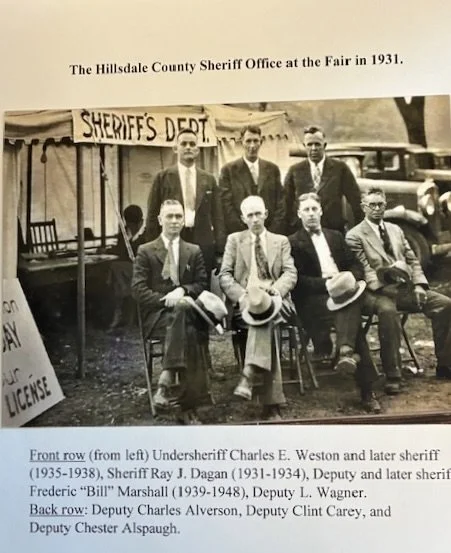
Hillsdale County Sheriff’s Office
In the earliest days of Hillsdale County, public safety and order were informal and a collective responsibility of the community. The first county sheriff was elected in 1836, serving two years. The sheriff—and jail—were in Jonesville, which was the county seat. It’s probable that unlawful behavior was met with a call for men to be deputized to go after the lawbreakers.
Although Jonesville was the first county seat, a dispute with Hillsdale for that designation led to valiant, but somewhat dubious actions by Jonesville supporters. Hillsdale had preemptively announced its importance to the county by designating a “Courthouse Square” on its 1837 plat map. In 1843, discovering Jonesville’s ruse, the Michigan Legislature declared that Hillsdale’s dream would become reality. With the 1843 Legislative decision, a pathetically inadequate log cabin was hastily erected on their “Courthouse Square” and called the Courthouse. Although the Jonesville Courthouse had a jail, there is no record of a jail on the Hillsdale site for the first three years. In 1846 one was built for $2,999. It lasted, with periodic jail breaks, until it burned almost to the ground in 1877, with yet another prisoner getting away in the confusion. It’s a mystery where inmates were housed until 1883 when another jail, with quarters for the sheriff and his family, was erected on the northeast corner of Courthouse Square. Its style was described in the newspaper as having a “composite architecture … a union of an art gallery, a church-yard vault, and a country livery-stable, with some ragged features that suggest that the whole had made a notable attempt to withstand an earthquake or a hurricane.”
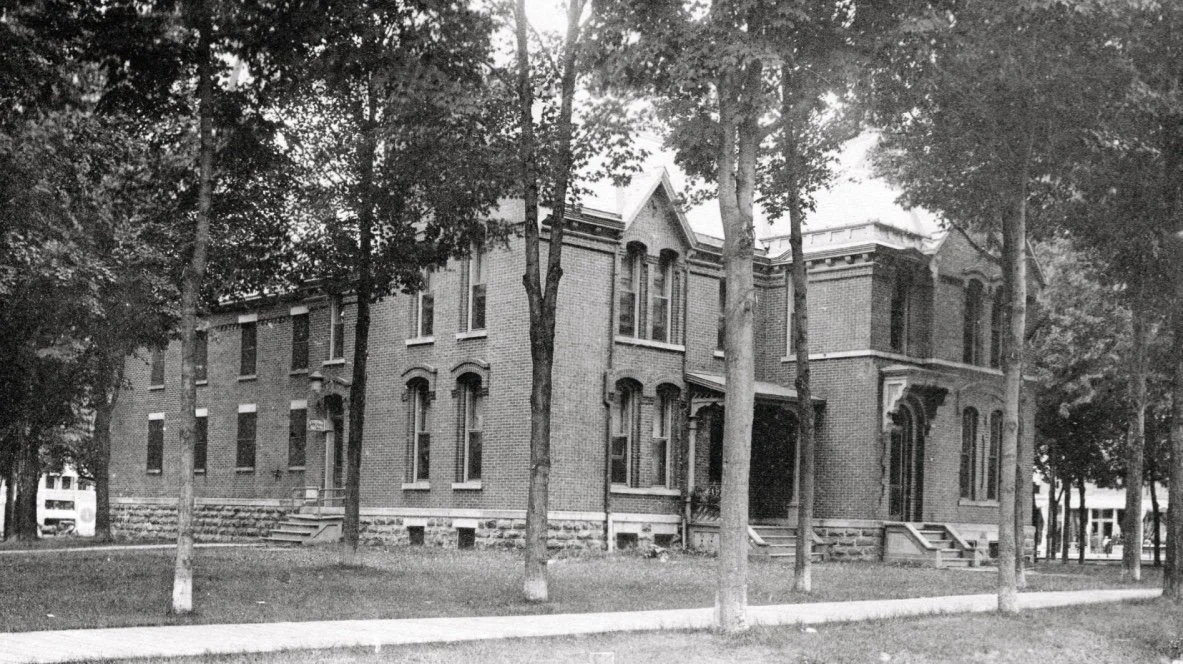
As well as falling short of being an attractive building, the new jail wasn’t escape-proof. In 1894 “seven of the worst criminals in custody” made their escape through a large hole they created in the side of the building. Three of the men were accused of burglary, another of rape and the last three for the attempted murder of Postmaster Weatherwax of Somerset. (Although Mr. Weatherwax was shot two times, he fought them off with a kerosene lamp, beating one so severely over the head that his scalp was badly lacerated.)
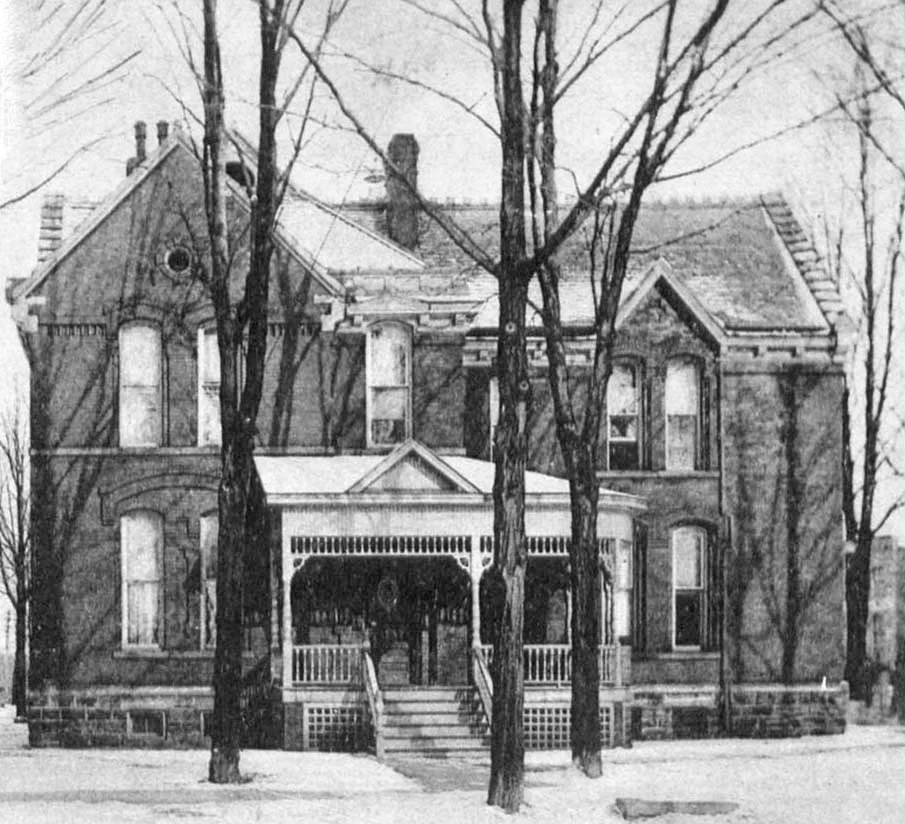
Those seven men planned their escape carefully. A confederate on the outside of the jail surreptitiously passed a gun to the men inside. They used this to intimidate the other inmates held in the jail while they used a bench and box to build a fire that heated the stone lining of the jail to a point where it cracked. With an iron bar they had removed from the old-fashioned toilet “drop,” they chipped away at the stone, loosened the bricks and then took off. The escapees had an unwitting partner, a new and inexperienced turnkey (jailer). Instead of laying eyes on each prisoner to be sure all were present and locked in their cells that night, he simply called from the end of corridor leading to the cells, “Is everyone there?” They all called back—the seven aspiring escapees from outside their cells.
The large hole left in the outside wall of the jail provided excellent entertainment value for the gawkers who stopped by.
By the early 1970s termites had taken over the jail. Despite an attempt by the Hillsdale County Historical Society to save it, perhaps to use as a museum featuring the Conklin organ collection, the Hillsdale County Board of Commissioners voted to demolish it. A new jail was opened in 1974 on Fayette Street.
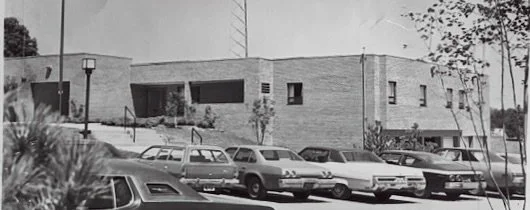
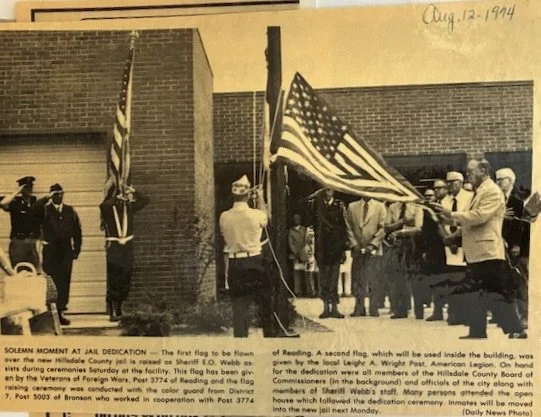
A community open house at the new jail made it clear that inmates wouldn’t be housed in the lap of luxury. There were no nonsense bunk beds with thin mattresses in dorm-like cells. While it was still a lock-up, greater emphasis on rehabilitation led to programs that prepared inmates for success when they re-entered society. During the tenure of Sheriff Tim Parker in the latter 2010s, inmates planted a garden for their own use in the fenced area around the jail. Initially, it only included carrots and beans, but it was a chance for some to get out of their cells and into the fresh air. Donations from Jonesville Lumber Company and Family Farm and Home meant that the county had no expenses. With the decision to contract for meal preparation with an outside agency instead of it remaining in-house, State regulations dictated that all food served at the jail be supplied by the contracting agency. Currently, two trustees assist the cooks with food preparation.
By far the most popular rehabilitation program was one in which inmates with clean records while serving their sentences left the jail during the day with a Deputy who acted as their supervisor. The City of Hillsdale, the Hillsdale Community Health Center and the Hillsdale County Fairgrounds contracted with the Sheriff’s Department to have “trustees” do general maintenance and cleaning. These organizations paid about $26 per hour, which covered the salary of a program director. Per year, the program cost about $60,000, with about $40,000 in income from the contracting entities. The final $20,000 came from the County Commissioners’ budget. The recession that hit the whole country around 2008 led to the necessity to cut money in the Sheriff’s budget. The Sheriff’s Office and the Commissioners pointed fingers at each other when the former removed the inmate labor item from their 2011 budget. Today, those doing “community service” as part of their non-custodial sentence provide labor to non-profit organizations. The probationers pay $25 to get on this program, and that money is used for education programs for the schools.
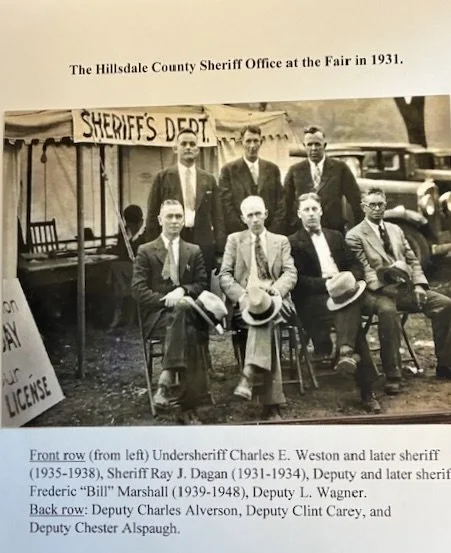
Although towns around the county established their own police departments, the Sheriff’s Office, assisted by the State Police, patrol the entire county. All detainees in the county, as well as people serving a sentence, are lodged at the Sheriff’s Office. Local police departments utilize specialized departments developed by the Sheriff’s Office. These include a dive team (1985), Naloxone training to administer to people suspected of having overdosed (2017), a Victim Services Unit (2017), a mounted patrol, a marine patrol, canine teams to walk through schools, animal control and training for a response to a school shooter.
Through the years technology has increased the effectiveness and efficiency of the Sheriff’s Office. Balancing the right of the public to privacy and the right of the public—as well as the responding police—to be safe isn’t always easy. After the horrific attack on September 11, 2001, United States Department of Homeland Security grants allowed local towns and counties to purchase items that would augment the security measures already in place. In 2003 an emergency mobile response command bus was added. It was utilized once or twice and was parked at the Hillsdale County Fair during 2015 and 2016. Eventually it was returned to the government. In 2008 a ZISTOS Detection Deterrence Search and Surveillance System provided a way to see around corners or find objects to assess a situation. In 2020 a drone was added for mapping crime scenes and traffic accidents.
The Hillsdale County Sheriff’s Office 911 Central Dispatch, funded by a county millage and the County Commission budget, directs first responders across the county to medical, fire and police emergencies. It’s a system that brings trained assistance quickly when it’s needed.
JoAnne P. Miller
Thanks to the Hillsdale County Sheriff’s Office for sharing some of their photos and for their patient answering of questions. Any inadvertent errors of fact are mine.